
USP 797 and cGMP
How Clarix addresses USP 797 sterile compounding standards and 21 CFR Part 211 cGMP requirements for 503B outsourcing facilities.
USP <797> and cGMP Compliance
For a 503B outsourcing facility, two regulatory frameworks define the quality standard for sterile compounding: USP <797> (the United States Pharmacopeia chapter on pharmaceutical compounding of sterile preparations) and 21 CFR Part 211 (the FDA's current Good Manufacturing Practice regulations). Together, they form the backbone of what an FDA inspector will examine during an inspection.
This page explains the key requirements of each standard and how Clarix addresses them — not as an abstract technical exercise, but in practical terms your team can point to on the shop floor.
503B outsourcing facilities are FDA-registered and subject to both USP <797> and cGMP requirements. This is a higher bar than traditional 503A compounding pharmacies, which are primarily state-regulated. Clarix is purpose-built for this higher standard.
USP <797> — Sterile Compounding Standards
USP <797> covers every aspect of how sterile preparations must be compounded, tested, and documented. Below are the major requirement areas and how Clarix supports each one.
Personnel training and qualifications
What USP <797> requires: All personnel involved in sterile compounding must be trained and qualified. This includes initial competency assessment, ongoing training, media fill qualification (every 6 months), garbing qualification, and gloved fingertip testing. Records of all qualifications must be maintained.
How Clarix addresses it:
The Training module is the personnel qualification record system for your facility. It supports:
- Training plans — Define the SOPs, videos, and competency assessments that each role must complete. Plans can be assigned to individuals or entire role groups.
- Training matrix — A grid view showing every staff member's completion status across all assigned training items, with color-coded compliance status.
- Media fill records — Log media fill qualification outcomes linked to the personnel record. The system enforces a 6-month expiry and will block a technician from being assigned to batch production if their media fill qualification is expired or missing.
- Garbing qualification — Track annual garbing assessments per person.
- Gloved fingertip testing — Log test results with date, colony count, and outcome.
- Expiry alerts — The dashboard surfaces staff members with overdue or expiring qualifications so supervisors can act before a compliance gap occurs.
Server-side enforcement: When a user attempts to start or execute a batch step, Clarix checks their training record in real time. If any required training qualification is expired, execution is blocked at the server level — the system will not allow a batch step to proceed regardless of role. This ensures the qualification gate cannot be bypassed, even by administrators.
When an inspector asks for a training compliance report, you can generate it from Reports → Training Compliance with a date range and staff filter.
Environmental monitoring program
What USP <797> requires: A documented environmental monitoring (EM) program covering viable air sampling, viable surface sampling, and non-viable particle monitoring. Alert and action limits must be defined. Excursions must be investigated and linked to any batches that may have been affected. Trend data must be retained.
How Clarix addresses it:
The Environmental Monitoring module manages your entire EM program:
- Sampling locations — Define your sampling map: cleanroom, ante-area, ISO 5 hood, and any other monitored locations.
- Sample schedules — Set the required frequency (daily, weekly, monthly) for each location and sample type. The system generates overdue alerts when samples are not logged on time.
- Sample entry — Log viable air samples (CFU/m³), surface samples (CFU/contact plate), and particle counts. Results are checked against your configured alert and action limits in real time.
- Excursion management — When a result exceeds an action limit, the system automatically creates an excursion record. The excursion includes an assessment of any batches that were in-process at the time, which can inform your investigation.
- Trend analysis — Charts showing CFU trends over time per location and sample type, with control chart visualization.
- EM reports — Export EM data by date range for regulatory submissions or annual program reviews.
Beyond-use dating
What USP <797> requires: Every sterile preparation must have a beyond-use date (BUD) assigned based on its preparation category, storage conditions, and whether sterility testing was performed.
How Clarix addresses it:
The BUD field is defined at the formula level. When you author a Master Formula in Clarix, you specify the USP <797> category (Category 1, 2, or 3) and the storage condition. Clarix automatically calculates the maximum allowable BUD based on the revised USP <797> tables and populates that BUD on every batch created from that formula.
The BUD is printed on the batch MBR PDF and on any labels generated for the batch. It cannot be overridden without a documented deviation and PIC approval.
| USP Category | Conditions | Maximum BUD |
|---|---|---|
| Category 1 | ISO 5, no sterility testing | 12 hours (any temperature) |
| Category 2 | ISO 5 within ISO 7/8, no sterility testing | 1–45 days (varies by temperature) |
| Category 3 | ISO 5 within ISO 7/8, sterility testing per USP <71> | Extended dating with stability data |
Master formula requirements
What USP <797> requires: A Master Formula Record (MFR) must exist for every preparation and must include: the name and strength of all components, their quantities, compounding equipment, step-by-step preparation instructions, in-process quality checks, and BUD assignment. The MFR must be reviewed and approved before use.
How Clarix addresses it:
The Formulas module is where your MFRs live. Each formula in Clarix includes:
- Bill of Materials (BOM) — Every ingredient with quantity, unit, supplier, and grade
- Compounding steps — Ordered, step-by-step instructions with embedded quality checks, required measurements, and e-signature gates
- Equipment requirements — Which calibrated equipment is required for each step
- BUD configuration — Category and storage condition
- Formula versioning — Every change creates a new version. Previous versions are retained in full and can be viewed or exported at any time.
- Approval workflow — A formula must be reviewed and approved by the PIC with an e-signature before any batch can use it. The approval is logged in the audit trail.
Any batch created from a formula uses the exact version of the formula that was approved at the time of batch creation. If the formula is later revised, existing in-progress batches are not affected.
Batch production records
What USP <797> requires: A Compounding Production Record (CPR) must be created for every batch. It must document: the formula version used, component lot numbers and quantities issued, equipment used, all compounding steps with initials and dates, QA review, and final release.
How Clarix addresses it:
The Batches module is the CPR system. When a batch is created from an approved formula, Clarix generates the full CPR structure automatically. During execution:
- Technicians execute each step in order — the system will not allow steps to be skipped or completed out of sequence
- Each ingredient is issued from inventory by lot number, and the quantity issued is logged
- Critical steps require a second verifier (configurable per formula step)
- E-signatures are captured at each required gate
- The completed batch undergoes QA review (QA Officer) and PIC release (Pharmacist-in-Charge) before it is marked released
At any point — during execution or after release — you can generate the MBR PDF for that batch. The PDF is a human-readable record of everything that happened during the batch, formatted for regulatory submission or inspection.
QA oversight
What USP <797> requires: A quality assurance program covering deviation management, corrective and preventive actions (CAPAs), and documented QA review of batch records before release.
How Clarix addresses it:
The Quality module manages deviations and CAPAs:
- Deviations — Log any departure from the formula, procedure, or specification. Each deviation has a description, severity level (minor, major, critical), root cause investigation, impact assessment, and disposition.
- CAPAs — Linked to deviations. Each CAPA has an action plan, responsible person, due date, and an effectiveness verification step.
- Batch QA review gate — Before a batch can be released, a QA Officer must review the complete batch record and sign off. The system prevents PIC release until QA review is complete.
cGMP — 21 CFR Part 211
The FDA's cGMP regulations (21 CFR Part 211) apply to 503B outsourcing facilities and establish requirements for organization, personnel, buildings, equipment, laboratory controls, production records, and more. Below are the major areas and how Clarix addresses each.
Production and process controls (§ 211.100–211.115)
What cGMP requires: Written procedures for production and process control. Each batch production record must be prepared from the master production record. Deviations must be recorded and justified.
How Clarix addresses it: The formula-to-batch workflow enforces this automatically. The approved Master Formula is the master production record. Each batch CPR is generated from it. Deviations are logged in the Quality module with required justification and disposition. The entire process is guided, sequential, and audited.
Laboratory controls (§ 211.160–211.198)
What cGMP requires: A documented laboratory control system covering specifications, testing methods, and out-of-specification (OOS) investigation procedures for finished products.
How Clarix addresses it:
The Lab Samples module manages QC testing linked to batches:
- Log sterility test results (per USP <71>), endotoxin / LAL results (per USP <85>), and other QC tests
- Each sample is linked to the specific batch lot
- Results are checked against predefined specification limits
- OOS results trigger an automatic deviation record for investigation
Records and reports (§ 211.180–211.198)
What cGMP requires: All required records must be readily retrievable, retained for at least one year past the product's expiry, and available for FDA inspection.
How Clarix addresses it: All records in Clarix are retained indefinitely and can be retrieved by date, batch number, formula, lot number, or user. The audit trail is complete and immutable. The batch MBR PDF can be generated and printed on demand. Records are stored with automated backups and cannot be deleted.
Equipment qualification (§ 211.68, § 211.100)
What cGMP requires: Equipment must be qualified, calibrated, and maintained. Calibration status must be current before equipment is used in production. Calibration records must be retained.
How Clarix addresses it:
The Equipment module maintains your asset registry:
- Every piece of equipment has a record with manufacturer, model, serial number, installation date, and ISO classification (for classified rooms)
- Calibration schedules are configured per instrument (frequency, tolerance)
- Calibration events are logged with date, performed-by, result, and next-due date
- Preventive maintenance logs track cleaning, filter changes, and HEPA certification
- Overdue calibration blocks production — if a piece of equipment is overdue for calibration, it cannot be selected during batch step execution until a new calibration is logged
The dashboard surfaces calibration overdue alerts so equipment technicians can act before a batch is held up.
Personnel qualifications (§ 211.25, § 211.68)
What cGMP requires: Personnel responsible for manufacturing, processing, packing, or holding of drug products must have appropriate education, training, and experience.
How Clarix addresses it: The Training module covers cGMP personnel qualification in the same way it addresses USP <797> personnel requirements. Training plans, completion records, and competency assessments are maintained per individual. A training compliance report is available for any date range.
503B-specific considerations
As an FDA-registered 503B outsourcing facility, your documentation requirements are more rigorous than a traditional 503A pharmacy:
- Volume and scale — 503B facilities produce larger batches for distribution beyond the individual patient, requiring more formal production records and QA controls
- FDA registration and inspection — You are subject to FDA inspection under the same authority as drug manufacturers. Your electronic records system must be inspection-ready at all times
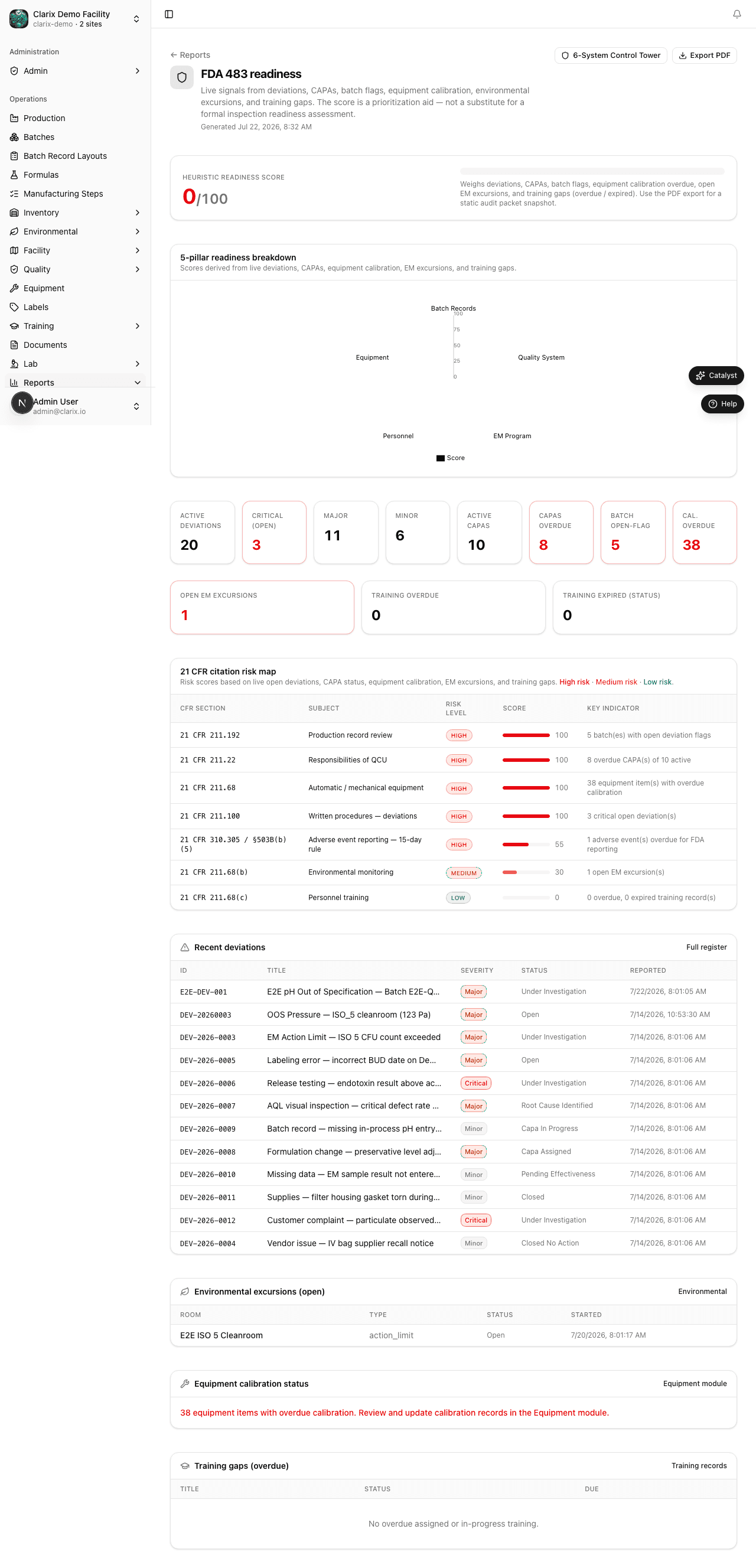
- Annual facility registration — Clarix's Reports module includes a 483 Readiness Report that scores your facility's documentation posture across the major inspection areas, helping you identify gaps before an inspector does
- Product submissions — Some 503B products require notification to FDA. Documentation generated from Clarix (MBR PDFs, batch records) can support these submissions
Run Reports → 483 Readiness regularly as part of your quality program. The report identifies open deviations without CAPAs, expired qualifications, overdue environmental monitoring, and calibration gaps — the exact categories an inspector will check.
Related pages
- 21 CFR Part 11 — Electronic records and signatures requirements
- E-Signatures and Audit Trail — How signatures are captured and stored
- Formulas Overview — Building compliant Master Formula Records
- Batches Overview — The full batch lifecycle from creation to release
- Quality Overview — Deviation and CAPA management