
Quality Management System
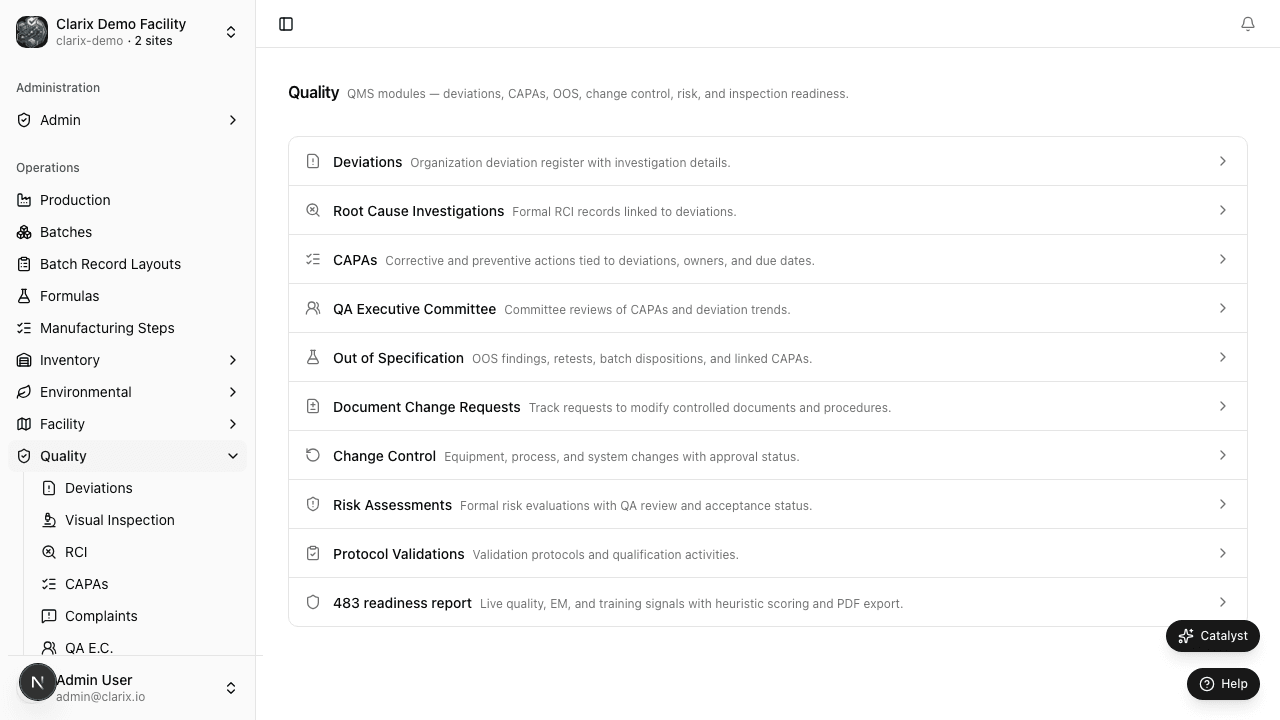
A complete overview of Clarix's Quality Management System — the hub for all quality events, investigations, corrective actions, and FDA readiness in your 503B facility.
The Quality Management System (QMS) in Clarix is the central hub for all quality-related activities in your 503B sterile compounding facility. Every deviation, investigation, corrective action, document change, risk assessment, and validation protocol is created, tracked, and closed here — with a complete audit trail that supports FDA inspection readiness and USP ⟨797⟩ compliance.
Role required: Viewing QMS records requires the QA Technician role or higher. Creating new records requires QA Officer. Approving, closing, or escalating records requires QA Manager or PIC.
QMS record types
From the Quality section in the sidebar, you can access all eleven record types that make up the Clarix QMS:
| Record type | Purpose | Example number |
|---|---|---|
| Deviations | Any event that departs from an approved procedure or specification | DEV-2026-0001 |
| Root Cause Investigations | Formal investigation into why a deviation occurred | RCI-2026-0001 |
| CAPAs | Corrective and Preventive Actions to eliminate recurrence | CAPA-2026-0001 |
| OOS Results | Out-of-specification lab results for finished products | OOS-2026-0001 |
| Complaints & Adverse Events | Product complaints and adverse events per 21 CFR 211.198 and §503B(b)(5); 15-day FDA reporting window for serious AEs | COMP-2026-0001 |
| Visual Inspection | 100% first-pass and AQL second-pass inspection per FDA VI Guidance (Dec 2021) and USP ⟨790⟩ | VI-2026-0001 |
| Media Fills | Semi-annual aseptic process simulations per 21 CFR 211.113(b) and USP ⟨797⟩ | MF-2026-0001 |
| Document Change Requests | Formal requests to revise controlled documents | DCR-2026-0001 |
| Change Control | Structured management of facility, equipment, or process changes | CC-2026-0001 |
| Risk Assessments | Documented scoring of process or product risks | RA-2026-0001 |
| Protocol Validation | IQ/OQ/PQ and method validation protocols and execution records | PROT-2026-0001 |
The core quality chain: Deviation → RCI → CAPA
The most common workflow in the QMS follows a three-step chain that ensures every quality event is not just documented, but fully investigated and permanently resolved.
Step 1 — Deviation
A deviation captures the fact that something did not go according to plan. It is opened at the moment the event is observed — during batch production, environmental monitoring, lab testing, or equipment operation. Deviations are classified by severity so that the response is proportional to the risk.
Step 2 — Root Cause Investigation (RCI)
Once a deviation is open, a formal root cause investigation is linked to it. The RCI documents the methodology used (fishbone diagram, 5-Why analysis, fault tree), the findings, and the confirmed root cause category. Without a completed RCI, you cannot determine what went wrong — only that something did.
Step 3 — CAPA
A CAPA (Corrective and Preventive Action) is opened from the completed RCI. The corrective action addresses the immediate problem; the preventive action changes the system to prevent it from happening again. CAPAs have assigned owners, due dates, and a verification step that confirms the action was effective.
Not every deviation requires an RCI or CAPA. Minor administrative deviations may be resolved directly. However, any Critical or Major deviation must have a linked RCI, and any confirmed systemic root cause must have a CAPA.
Deviation severity levels
All deviations, OOS results, and quality events are classified at one of three severity levels. Severity drives investigation timelines, escalation requirements, and CAPA deadlines.
| Severity | Definition | Examples | CAPA deadline |
|---|---|---|---|
| Critical | Potential or actual patient safety impact | Sterility failure, wrong drug, dose error ≥ 10×, critical EM excursion | 24 hours |
| Major | Significant impact on product quality or regulatory compliance | Yield below 75%, major EM excursion, equipment failure mid-batch | 5 business days |
| Minor | Limited impact; procedural or documentation event | Late signature, minor weight deviation within spec, label error caught before release | 30 days |
Automatic deviation creation
Clarix automatically opens deviations in two situations so that nothing slips through:
- Yield below 75%: When a batch's calculated yield falls below 75% at step completion, a Major deviation (DEV-YYYY-NNNN) is created and linked to that batch automatically. The deviation appears in the QMS list and on the batch detail page.
- EM excursion: When an environmental monitoring sample exceeds its action limit and the EM excursion rule is enabled for your organization, a deviation is automatically created and linked to the relevant EM record.
In both cases, the auto-created deviation is pre-populated with the source information and marked Open. A QA officer must review, assign an investigator, and move it forward.
483 Readiness
The 483 Readiness report (found under Reports → 483 Readiness) aggregates the current state of your QMS to highlight gaps that an FDA investigator would note on a Form 483. It surfaces:
- Overdue CAPAs
- Deviations open longer than 30 days without an RCI
- Critical deviations without a linked CAPA
- Change controls pending approval beyond their target date
- Validation protocols due for periodic review
Keeping this report clear — no red items — is the best ongoing preparation for a surprise inspection.
Audit trail
Every action taken on any QMS record is permanently recorded in the Clarix audit trail: who created a record, who changed a field, who added a comment, who closed it, and when. The audit trail cannot be edited or deleted. This supports 21 CFR Part 11 electronic records requirements and provides the evidence base for FDA inspection responses.
Related pages
Inventory Import
How to bulk-import inventory items and lots into Clarix using CSV files, including template download, column mapping, and error resolution.
Deviations
How to create, investigate, and close deviations in Clarix — covering severity classification, sources, lifecycle states, and automatic deviation rules for 503B compounding.