
Inventory Overview
How Clarix tracks pharmaceutical raw materials at the lot level — including FIFO management, expiry monitoring, COA storage, and quarantine controls.
Clarix Inventory provides lot-level traceability for every raw material used in sterile and non-sterile compounding. Every received shipment is tracked as a discrete lot with its own quantity, expiry date, Certificate of Analysis (COA), and status. This granular tracking is essential for 503B facilities — it supports FDA traceability expectations, enables rapid recall response, and ensures that only released, in-date materials are used in batch production.
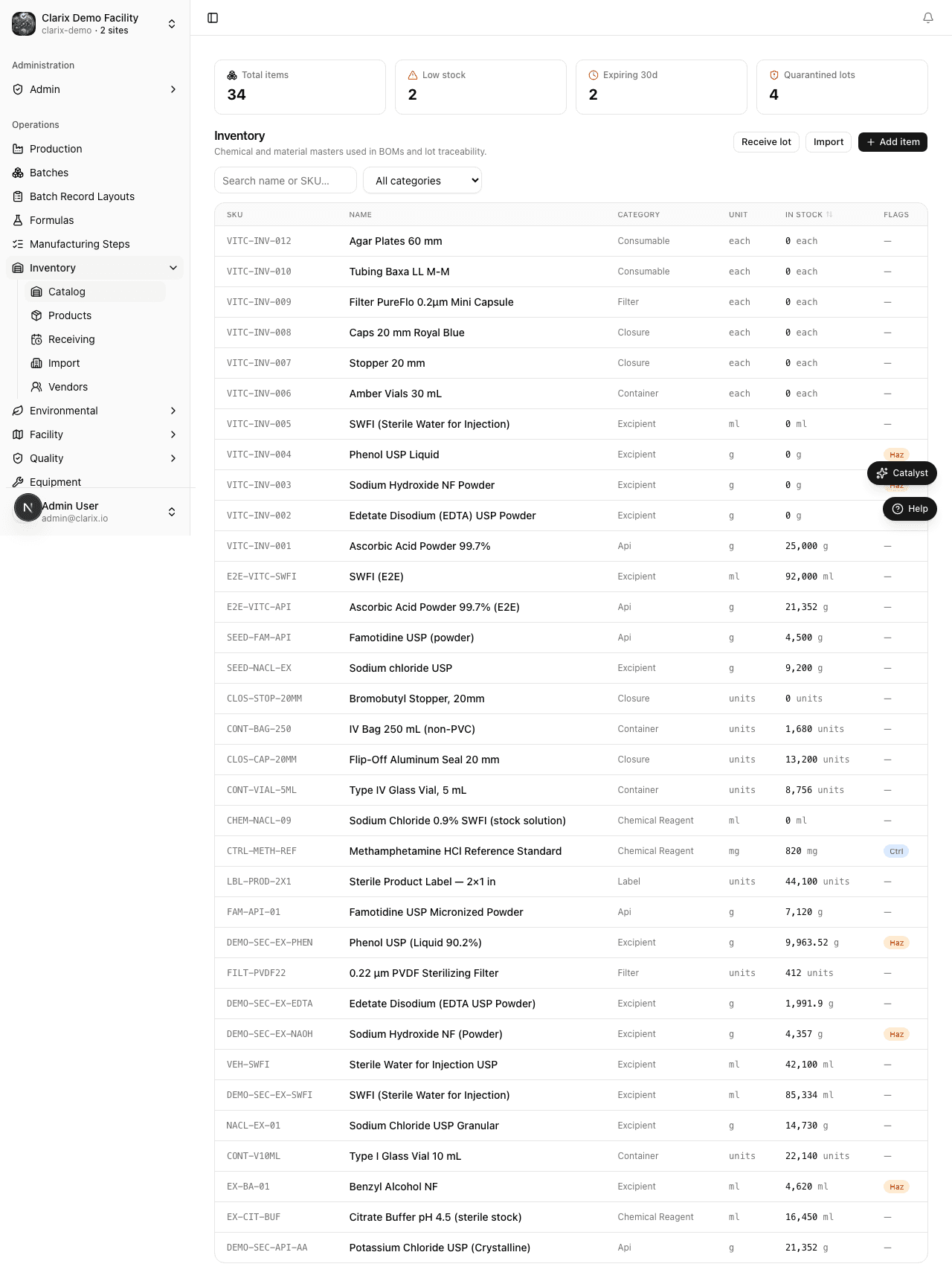
Key concepts
Material masters vs. lots
Clarix uses a two-level inventory model:
| Level | What it represents | Example |
|---|---|---|
| Inventory item (material master) | The generic material — its name, specifications, and configuration | "Ascorbic Acid Powder 99.7%" |
| Lot | A specific received shipment of that material — with its own lot number, quantity, expiry, and COA | "Lot 2024-A-047, received June 1 2026, 500 g, assay 97.2%" |
Think of it this way: the item is the ingredient; the lot is the physical container in your storeroom. A single item can have many lots on hand simultaneously — from different manufacturers, different shipments, or different dates.
FIFO management
Clarix enforces First In, First Out (FIFO) lot selection by default. When a batch requires an ingredient, the system recommends the oldest released lot first, minimizing the risk of materials expiring before use. Batch managers can override FIFO lot selection but the override is logged.
COA on file
Every lot in Clarix can store the Certificate of Analysis (COA) assay value provided by the supplier. This percentage (e.g., 97.2%) is used in two ways:
- Purity-adjusted calculations — formula calculation steps can use
component["Name"].purityto automatically adjust the required weight/volume based on actual lot potency. - Compliance reference — the COA assay is printed on the batch record and provides traceability from finished product to raw material quality data.
Quarantine controls
Every newly received lot starts in Quarantined status. A quarantined lot cannot be issued to a batch, even if it has a valid expiry date and assay. A QA officer must review the lot and explicitly Release it before it becomes available for production. This ensures that every material used in compounding has passed an incoming QC check.
The inventory dashboard
At the top of the Inventory catalog page, four summary cards give you an at-a-glance view of your current inventory health:
| Card | What it shows |
|---|---|
| Total items | Number of distinct material master records |
| Low stock | Number of items where the current on-hand quantity is at or below the reorder threshold |
| Expiring soon | Number of lots expiring within the next 30 days |
| Quarantined | Number of lots currently in Quarantined status |
Click any card to jump to a filtered view of the relevant items or lots.
Navigating the inventory catalog
The inventory catalog table shows all material masters with summary columns:
| Column | Description |
|---|---|
| Item name | Linked to the item detail page |
| Category | API, excipient, diluent, packaging, etc. |
| Unit | Default unit of measure |
| On hand | Total quantity across all released lots |
| Lots | Number of active lots (released + quarantined) |
| Reorder threshold | The quantity at which a low-stock alert is triggered |
| Status | Normal, Low stock, or Out of stock |
Use the search bar to find items by name or NDC. Use the Category and Status filters to narrow the view.
Finished products catalog
The Products tab at /inventory/products lists finished compounded products linked to approved Master Formulas — for example, Ascorbic Acid 500 mg/mL 30 mL IV (VITC-489). Each row shows the product name, formula reference, and on-hand finished-goods quantity.
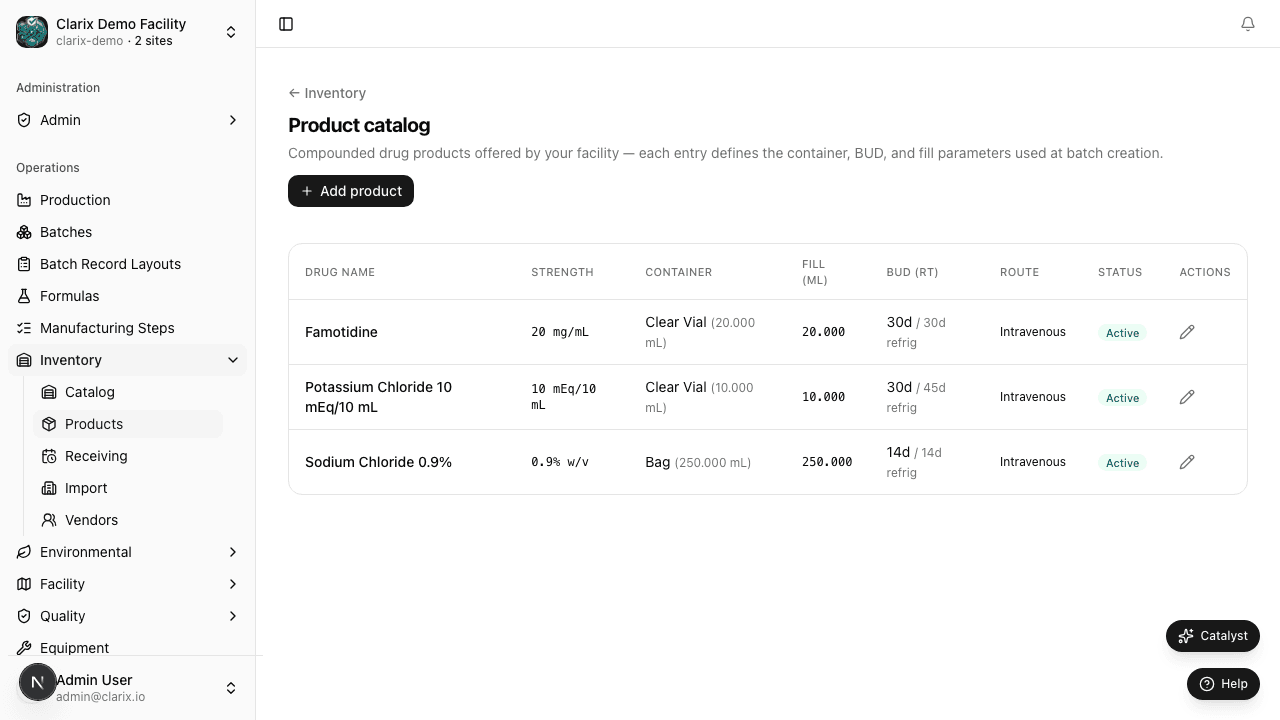
Use this view to reconcile dispensed inventory against released batches and to plan production for high-demand SKUs.
Traceability and compliance
Clarix's inventory module is designed to support the traceability requirements that FDA inspectors look for during 503B facility inspections:
- Lot-level issuance — every batch record captures the exact lot numbers and quantities of each ingredient used
- Full forward and backward traceability — from a raw material lot, you can see every batch it was used in; from a batch, you can trace every lot used
- COA retention — assay values are stored permanently with each lot record
- Audit log — every quantity adjustment, status change, and lot release is logged with user, timestamp, and reason
- Expiry enforcement — expired lots cannot be issued to batches; Clarix prevents the selection of lots past their expiry date
Related pages
Manufacturing Steps JSONL Import
Bulk-import reusable manufacturing steps at /manufacturing-steps/import using JSON Lines — one complete step object per line.
Managing Inventory Items
How to create, configure, and manage material master records (inventory items) in Clarix, including barcode policy and item settings.