
Out-of-Specification Results
How to record, investigate, and resolve Out-of-Specification (OOS) lab results for finished compounded products in Clarix.
An Out-of-Specification (OOS) result is a laboratory test result for a finished compounded product that falls outside the pre-established release specification. OOS results are distinct from general deviations — they specifically indicate that a finished or in-process product has failed a defined quality limit, and they trigger a rigorous two-phase investigation process that mirrors FDA guidance on OOS result handling.
In 503B sterile compounding, every finished batch must meet its release specifications before it can be dispensed. When a lab result falls outside those limits, the OOS record in Clarix initiates the investigation, documents the findings, and tracks the batch disposition decision — whether the product is released after invalidation, rejected and destroyed, or escalated further.
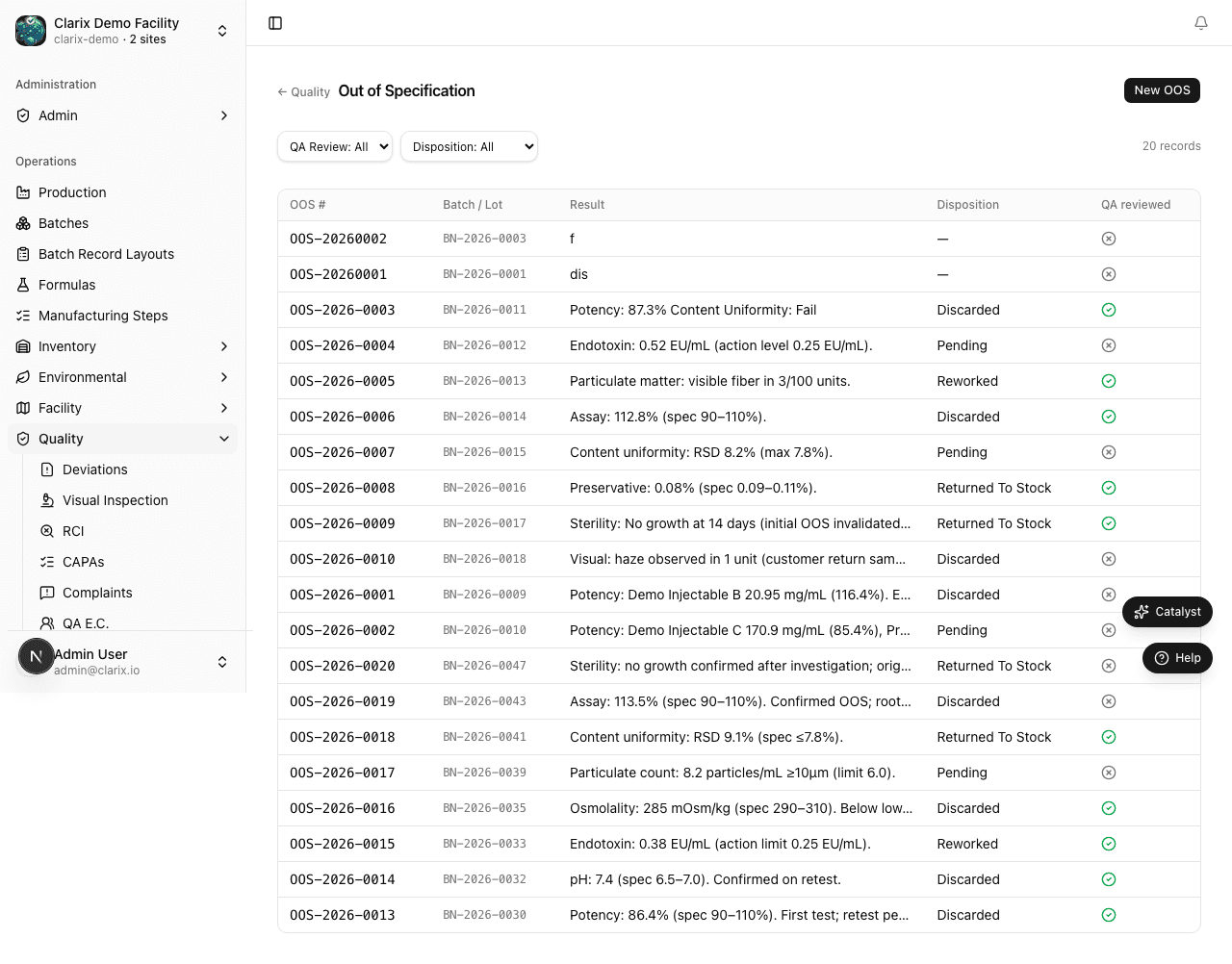
Role required: Viewing OOS records requires the QA Technician role or higher. Creating an OOS record requires Lab Analyst or QA Officer. Confirming, invalidating, or resolving an OOS requires QA Manager or PIC.
OOS vs. deviation — what is the difference?
These two record types are related but distinct:
| Aspect | OOS Result | Deviation |
|---|---|---|
| Scope | Specifically a laboratory test result outside a specification | Any departure from an approved procedure or expected outcome |
| Source | Always originates from a lab test result (assay, sterility, endotoxin, pH, particulates) | Batch production, environment, equipment, personnel, vendor, process |
| Outcome | Leads to product disposition decision (release, reject, invalidate) | Leads to investigation and corrective action |
| Batch impact | Directly blocks batch release until resolved | May or may not affect batch release depending on severity |
A confirmed OOS result will almost always generate a linked deviation (for the batch production failure) and typically requires a CAPA. OOS records and deviations are complementary — the OOS documents the specification failure; the deviation documents the quality event and drives the investigation.
What lab results trigger OOS records?
Any finished-product test that falls outside its specification should have an OOS record created. Common tests in 503B compounding include:
- Potency / assay — the concentration of active pharmaceutical ingredient(s) outside the specified range (e.g., 90–110% of label claim)
- Sterility — a positive sterility test result (any growth)
- Bacterial endotoxin (BET) — endotoxin concentration above the specified limit
- pH — outside the specified range for the formulation
- Particulate matter — visible or sub-visible particle count exceeding limits
- Osmolality / osmolarity — outside the specified physiological range
- Container closure integrity (CCI) — a failed seal integrity test
- Appearance / color / clarity — a failed visual inspection criterion
Creating an OOS record
- In the sidebar, navigate to Quality → OOS.
- Click New OOS in the top-right corner.
- Complete the required fields:
- Product / batch — the name of the product and the batch number (e.g., B-2026-0203) being tested
- Test method — the SOP or compendial method used (e.g., USP ⟨71⟩ Sterility, USP ⟨85⟩ BET, SOP-LAB-004)
- Specification limit — the pass/fail criterion as defined in the formula record (e.g., 90–110% of label claim, NMT 0.25 EU/mL, pH 6.8–7.2)
- Actual result — the value returned by the test (e.g., 84.2% of label claim, 0.38 EU/mL, pH 7.6)
- Sample ID — the lab sample tracking number used in your LIMS or on the sample label
- Analyst — the lab analyst who performed the test
- Test date — when the test was performed
- Instrument ID — the equipment used (relevant for Phase I investigation)
- Click Create OOS Record.
Clarix assigns a unique number in the format OOS-YYYY-NNNN — for example, OOS-2026-0001.
OOS investigation phases
FDA's 2006 guidance on investigation of OOS results defines a two-phase approach. Clarix structures the OOS workflow to follow these phases:
Phase I — Laboratory investigation
The first question is whether the OOS result is attributable to a laboratory error rather than a true product failure. Phase I is conducted entirely within the lab:
- Review analyst technique and calculations
- Check instrument calibration and function logs
- Review sample handling and preparation records
- Review method suitability and reagent status
If a laboratory error is confirmed (e.g., calculation error, wrong standard used, instrument malfunction not caused by product), the original result may be invalidated and a retest performed. The OOS record documents the invalidation reason in detail.
If no laboratory error is found, the investigation moves to Phase II.
Phase II — Manufacturing investigation
Phase II investigates whether the OOS result reflects a true product failure. This involves:
- Review of the batch record for the affected batch
- Inspection of retained samples
- Review of raw material CoAs and lot testing
- Interview of compounding staff
- Environmental monitoring data review
Phase II is conducted as a linked deviation and may generate a CAPA.
OOS lifecycle states
| State | Meaning |
|---|---|
| Open | The OOS has been created. Investigation has not yet started. The batch is on hold. |
| Under Investigation | Phase I (and possibly Phase II) investigation is in progress. |
| Invalidated | Investigation confirmed a laboratory error. The original result is voided; a valid retest result is documented. If the retest passes, the batch may proceed to release review. |
| Confirmed OOS | Investigation confirmed the product does not meet specification. The batch cannot be released. |
| Resolved | The disposition has been finalized — typically batch rejection for Confirmed OOS, or release approval after invalidation. A CAPA has been opened if required. |
Consequences of a confirmed OOS
A Confirmed OOS result is a serious quality event. The standard response is:
- Batch rejection — The affected batch is placed on reject quarantine and cannot be released for dispensing. Clarix updates the batch status to Rejected.
- Deviation — A Major or Critical deviation (depending on the test that failed) is opened and linked to the OOS record.
- CAPA — A CAPA is required for any confirmed OOS that is not isolated to a single easily explained event. Sterility failures and potency OOS results outside a narrow band always require CAPAs.
- Notification — Critical OOS results (sterility failures, endotoxin exceedances) require PIC notification and may require patient notification assessment depending on whether the batch had already been dispensed.
Related pages
CAPAs
How to create, manage, and verify Corrective and Preventive Actions (CAPAs) in Clarix — closing the quality loop after root cause investigations and preventing deviation recurrence.
Complaints & Adverse Events
How to record, investigate, and report product complaints and adverse events under 21 CFR 211.198 and FDCA §503B(b)(5), including the 15-day FDA reporting window for serious adverse events.