
Visual Inspection
How to conduct and record 100% first-pass and AQL second-pass visual inspections for compounded sterile preparations under FDA VI Guidance (Dec 2021) and USP ⟨790⟩.
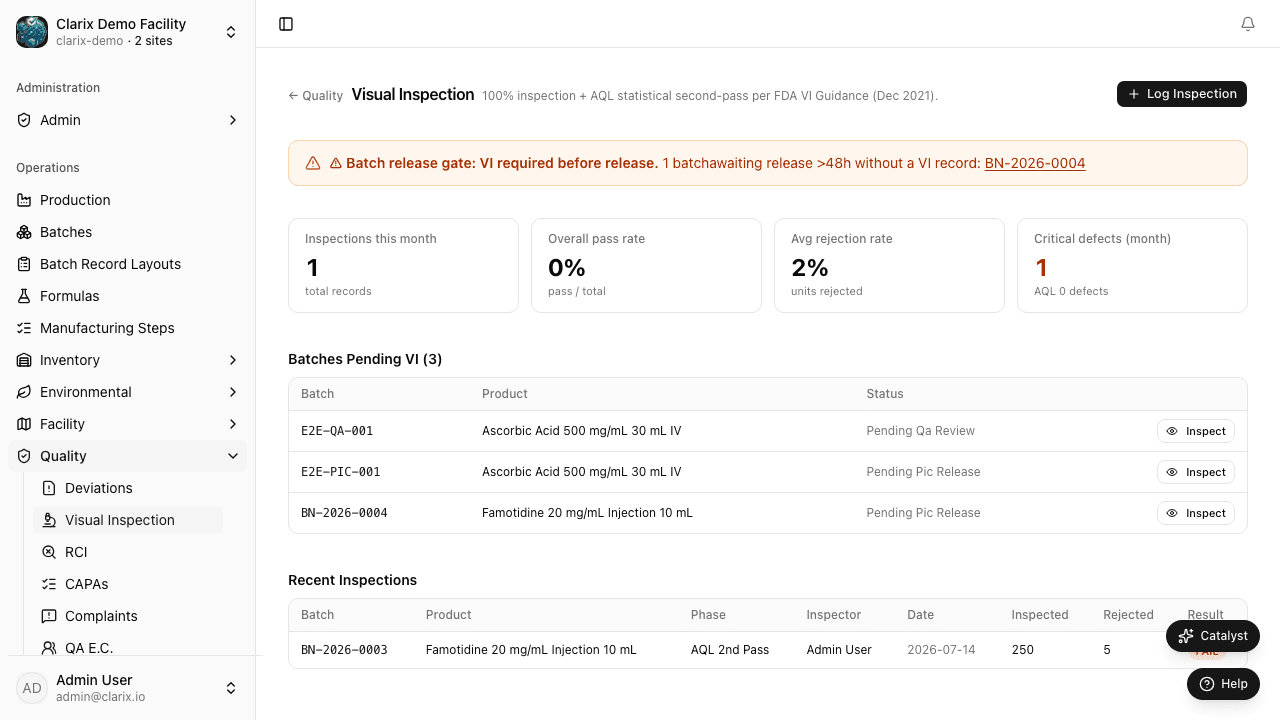
Visual Inspection (VI) is the final quality gate before any compounded sterile preparation leaves your facility. Every unit must be individually examined against a defined defect library — critically, major, and minor — and the result recorded before the batch can proceed to PIC release. Clarix enforces a two-tier inspection program: a mandatory 100% first-pass inspection of all units, followed by an AQL second-pass statistical sampling based on ANSI/ASQ Z1.4 for batches that pass the first tier.
Role required: Performing visual inspections requires the QA Technician role or higher. Reviewing inspection sessions and overriding automatic determinations requires QA Officer or higher. Final PASS/FAIL approval on a batch requires QA Manager or PIC.
How visual inspection fits in batch release
Regulatory and standards basis
| Authority | Requirement |
|---|---|
| FDA VI Guidance (Dec 2021) | 100% inspection of all injectable drug products; written program with defined defect library |
| USP ⟨790⟩ | Visible particulates — standards and procedures for injectable preparations |
| 21 CFR 211.68 | Written records of inspections required |
| ANSI/ASQ Z1.4 | Acceptance Quality Limit (AQL) sampling plans for second-pass statistical inspection |
The FDA December 2021 guidance on visual inspection of injectable drug products makes clear that a 100% inspection program — not statistical sampling alone — is the expected standard for sterile compounded preparations. AQL second-pass sampling supplements, rather than replaces, the 100% first-pass inspection.
The two-tier inspection program
Tier 1 — 100% first-pass inspection
Every unit in the batch is individually inspected by a trained inspector. Units are evaluated against the defect library (see below). Each unit receives one of three determinations:
| Determination | Meaning |
|---|---|
| Accept | Unit passes inspection; no defects observed |
| Reject | Unit fails inspection; a specific defect is recorded and the unit is removed from the batch |
| Reinspect | Inspector is uncertain; unit is set aside for re-examination by a second inspector |
After 100% first-pass is complete, Clarix calculates the reject rate for the batch. A reject rate above your configured threshold triggers an automatic Major deviation.
Tier 2 — AQL second-pass sampling
For batches that pass Tier 1, a statistically determined sample is drawn from the accepted units for a second-pass AQL inspection. Clarix calculates the sample size automatically based on:
- Batch size (number of units)
- Configured AQL level (typically 0.65 for critical defects, 1.0 for major, 4.0 for minor per ANSI/ASQ Z1.4)
- Inspection level (typically General Inspection Level II)
If the number of defects found in the AQL sample exceeds the acceptance number (Ac) for the configured plan, the entire batch is rejected.
Starting a visual inspection session
- Navigate to Quality → Visual Inspection in the sidebar.
- Click New Inspection.
- Select the Batch to be inspected.
- Select the Inspection tier: First Pass (100%) or Second Pass (AQL).
- Confirm the Inspector identity — your facility PIN will be required at completion.
- For second-pass AQL sessions, Clarix displays the required sample size based on your AQL configuration. Confirm the number of units to be inspected.
- Click Begin Inspection.
Inspecting units
For each unit presented during inspection:
- Select the determination: Accept, Reject, or Reinspect.
- If Reject, select the defect type from the defect library. You may select multiple defects for a single unit.
- Use the Notes field to add any clarifying observation (e.g., "particulate in lower third of vial, approximately 1 mm, non-mobile").
- Advance to the next unit.
Clarix displays a running tally of accepted, rejected, and pending units throughout the session.
Defect library
The defect library defines every defect category your inspectors evaluate against. Defects are pre-classified by severity:
Critical defects — immediate batch failure
| Defect | Description |
|---|---|
| Visible particulate — mobile | Any visible foreign particle that moves freely in solution |
| Visible particulate — stationary | Any visible foreign particle adhered to container wall or stopper |
| Container breach | Crack, puncture, or incomplete seal in vial, ampoule, or syringe |
| Wrong product or color | Solution color or appearance inconsistent with expected presentation |
| No solution present | Empty container or gross fill shortage |
Major defects — investigation required
| Defect | Description |
|---|---|
| Cloudiness or turbidity | Solution not clear when clarity is required per specification |
| Excessive air bubble | Air void that does not clear within defined time |
| Visible precipitate | Insoluble material not attributable to product formulation |
| Fill volume — significantly short | Measurably low fill detected visually |
| Label absent | No label present on unit |
Minor defects — documented; may not reject unit
| Defect | Description |
|---|---|
| Cosmetic container defect | Surface scratch or cosmetic mark on outer container |
| Label cosmetic | Label wrinkle, misalignment, or print quality issue that does not affect readability |
| Closure cosmetic | Minor visual imperfection on stopper or cap that does not affect seal |
Note: Your facility's QA Manager can extend the default defect library by adding custom defect entries in Settings → Quality Configuration. Custom entries must be classified as Critical, Major, or Minor at creation.
Automatic PASS/FAIL determination
At the conclusion of each inspection session, Clarix calculates the result automatically:
First-pass session:
- PASS — all units inspected; reject rate below configured threshold; no critical defects observed
- FAIL — any critical defect found, or reject rate above threshold; a Major or Critical deviation is automatically opened
Second-pass AQL session:
- PASS — number of defects in sample ≤ acceptance number (Ac) for the configured AQL plan
- FAIL — number of defects in sample ≥ rejection number (Re); batch is placed on hold and a deviation is automatically opened
A batch cannot advance to PIC release until both inspection tiers have recorded a PASS status.
Inspector qualification
FDA and USP ⟨790⟩ require that visual inspectors be trained and qualified. Clarix links VI results to the inspector's training record. If an inspector's VI qualification is expired or not on file, Clarix will display a warning when they attempt to start an inspection session.
Inspector qualification requirements:
- Initial training on the facility's written VI procedure
- Knapp test or equivalent vision acuity demonstration
- Annual requalification (or per facility SOP)
Configure inspector qualification intervals in Settings → Training Configuration.
Related pages
Complaints & Adverse Events
How to record, investigate, and report product complaints and adverse events under 21 CFR 211.198 and FDCA §503B(b)(5), including the 15-day FDA reporting window for serious adverse events.
Media Fill Tracker
Schedule, execute, and document aseptic process simulations (media fills) required by 21 CFR 211.113(b) and USP ⟨797⟩ for 503B sterile compounding facilities.